

Medically Reviewed by Dr. Kelvin Wong, DDS on September 23, 2026
Your dentist reviews your X-ray, checks your tooth, and tells you a crown is needed instead of a filling. It’s one of those moments where most patients nod along while quietly wondering why. The distinction between these two treatments is actually straightforward, and understanding it may help you feel more confident about the care you’re receiving.
At Cedar Smiles Dental in Somerset, New Jersey, Dr. Kelvin Wong takes the time to walk every patient through exactly what he finds and why he recommends a particular approach. As a private practice free from corporate quotas, we believe your treatment plan should reflect your tooth’s actual needs, not a production schedule. If you’ve been curious about how these decisions get made, our restorative dentistry services are built around that kind of honest, patient-first conversation.
What Do Crowns and Fillings Actually Do?
A filling and a crown are both restorative treatments, but they work differently and are appropriate for different situations.
Composite Filling
A composite filling removes decayed tooth material and fills the space directly with a tooth-colored resin bonded to the remaining structure. It’s a conservative approach, meaning your natural tooth is largely preserved. When decay is limited, and the surrounding structure is still solid, a filling is usually the most appropriate solution.
Dental Crown
A dental crown covers the entire visible portion of the tooth above the gumline. It’s used when the remaining tooth structure is too compromised for a filling to hold or function reliably over time. The American Dental Association notes that crowns can strengthen a tooth with a large filling when there isn’t enough natural tooth left to support it on its own.
What Factors Determine If You Need a Crown or Filling?
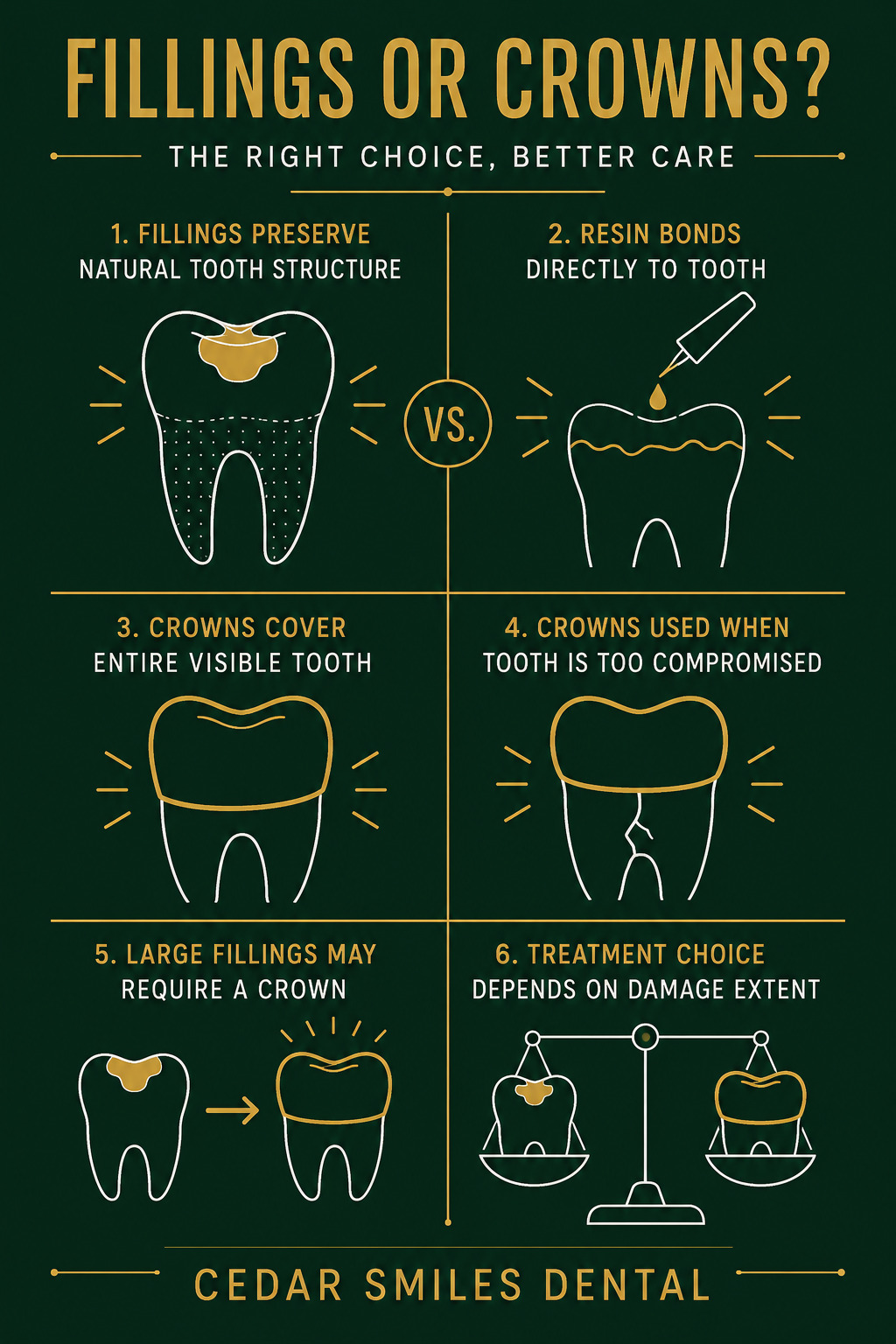
Dentists don’t choose between a crown and a filling based on preference. The recommendation follows a clear evaluation of several clinical factors.
How Much Healthy Tooth Remains
The most critical variable is how much sound tooth structure remains after the decay is removed. A small cavity leaves plenty of healthy walls behind for a filling to bond to and hold against normal pressure. A large or deep cavity may leave walls so thin that they risk fracturing under chewing force. When the remaining structure can’t reliably support a filling, a crown provides full coverage and distributes the load more evenly.
Whether the Tooth Has Been Restored Before
A tooth with an older, large filling is already structurally reduced. When new decay develops around or beneath it, removing both the decay and the failing filling sometimes takes the tooth below the threshold where another filling is predictable. This is one of the most common reasons patients who’ve had a tooth filled before end up needing a crown on that same tooth later.
Location and Bite Force
Back teeth absorb the heaviest chewing forces. A molar with a large cavity is under far more daily stress than a front tooth, and that influences how each restoration is expected to perform over time. Location matters when projecting long-term durability for either treatment option.
Cracks and Post-Root Canal Situations
A cracked tooth often needs a crown to hold the segments together and prevent the crack from progressing. A tooth following root canal therapy is also more brittle than a living tooth, because the pulp no longer supplies it with moisture. Crowns are frequently recommended on back teeth after root canal treatment for exactly this reason.
Knowing what your dentist is weighing helps you ask the right questions. No two teeth are identical, and the goal is always the most conservative option your tooth can reliably support.
Schedule Your Visit at Cedar Smiles Dental
Whether you’re dealing with a cavity you’ve been putting off or a tooth with an old filling you’re uncertain about, the right starting point is a thorough exam. Dr. Wong reviews digital X-rays with you, explains what he’s seeing in plain language, and discusses your options before any treatment begins. We also offer flexible financing options to help make the care your tooth needs more accessible.
Cedar Smiles Dental is a private practice built on the belief that every patient deserves time, attention, and straightforward answers. When you’re ready to find out what your tooth actually needs, contact our office to schedule your appointment.
How does a dentist decide whether you need a crown or a filling?
The decision depends primarily on how much healthy tooth structure remains after decay is removed. A filling is appropriate when the cavity is small and the remaining walls of the tooth are strong enough to hold the restoration and withstand normal chewing forces. A crown becomes necessary when decay is extensive, when a large portion of the tooth has been lost, or when the remaining structure is too thin to support a filling reliably. Your dentist will also consider whether the tooth has previous restorations, any cracks, and the level of bite force the tooth must handle each day.
Can a large cavity always be repaired with a filling?
Not always. When a cavity removes a significant portion of a tooth, the walls left behind may be too thin or fragile to support a filling long-term. Under chewing pressure, those thin walls can fracture, which often causes more damage than the original cavity. In those situations, a crown is recommended because it caps the entire visible portion of the tooth, distributing bite force across the full structure rather than concentrating it on a compromised wall. The goal is always to choose the most conservative option that your tooth can realistically support.
How long does a dental crown last compared to a filling?
Composite fillings typically last 5 to 10 years, though placement location and oral hygiene habits play a significant role. Porcelain or zirconia crowns generally last 10 to 15 years or longer with proper care. Crowns on back teeth that endure heavier bite forces may show wear sooner than crowns on front teeth. Consistent brushing, flossing, and professional cleanings extend the life of both restorations. Your dentist can assess any restoration at each routine exam and address early wear before it becomes a larger problem.
What happens if I delay getting a crown when my dentist recommends one?
Delaying a recommended crown gives a weakened tooth more time to fracture under daily chewing forces. A crack that extends below the gumline can make the tooth unrestorable, meaning extraction becomes the only option. Decay beneath an old filling can also progress further while you wait, potentially reaching the pulp and requiring root canal therapy before a crown can even be placed. Acting on the recommendation before the tooth breaks is nearly always more conservative, less expensive, and faster than treating the consequences of waiting.
ABOUT THE AUTHOR
Dr. Kelvin Wong, DDS
Dentist at Cedar Smiles Dental, Somerset, NJ
Dr. Kelvin Wong earned his Doctor of Dental Surgery degree from NYU College of Dentistry and is a Fellow of the International Congress of Oral Implantologists (ICOI). He completed advanced training at the Kois Center and brings scientific expertise and compassionate care to his private practice in Somerset, NJ.