

Modern cavity detection tools have changed what a routine dental exam can actually find. Where a dentist once relied mainly on a metal probe and their own eyes, today’s exams can identify decay in areas and at stages once impossible to spot. The result is more cavities caught early, less drilling, and fewer surprises down the road.
At Cedar Smiles Dental in Somerset, we take preventive dentistry seriously. Dr. Kelvin Wong founded this practice on a simple principle: listen first, then treat only what is truly necessary. That philosophy shapes how we approach every exam.
What Has Changed About Finding Cavities?
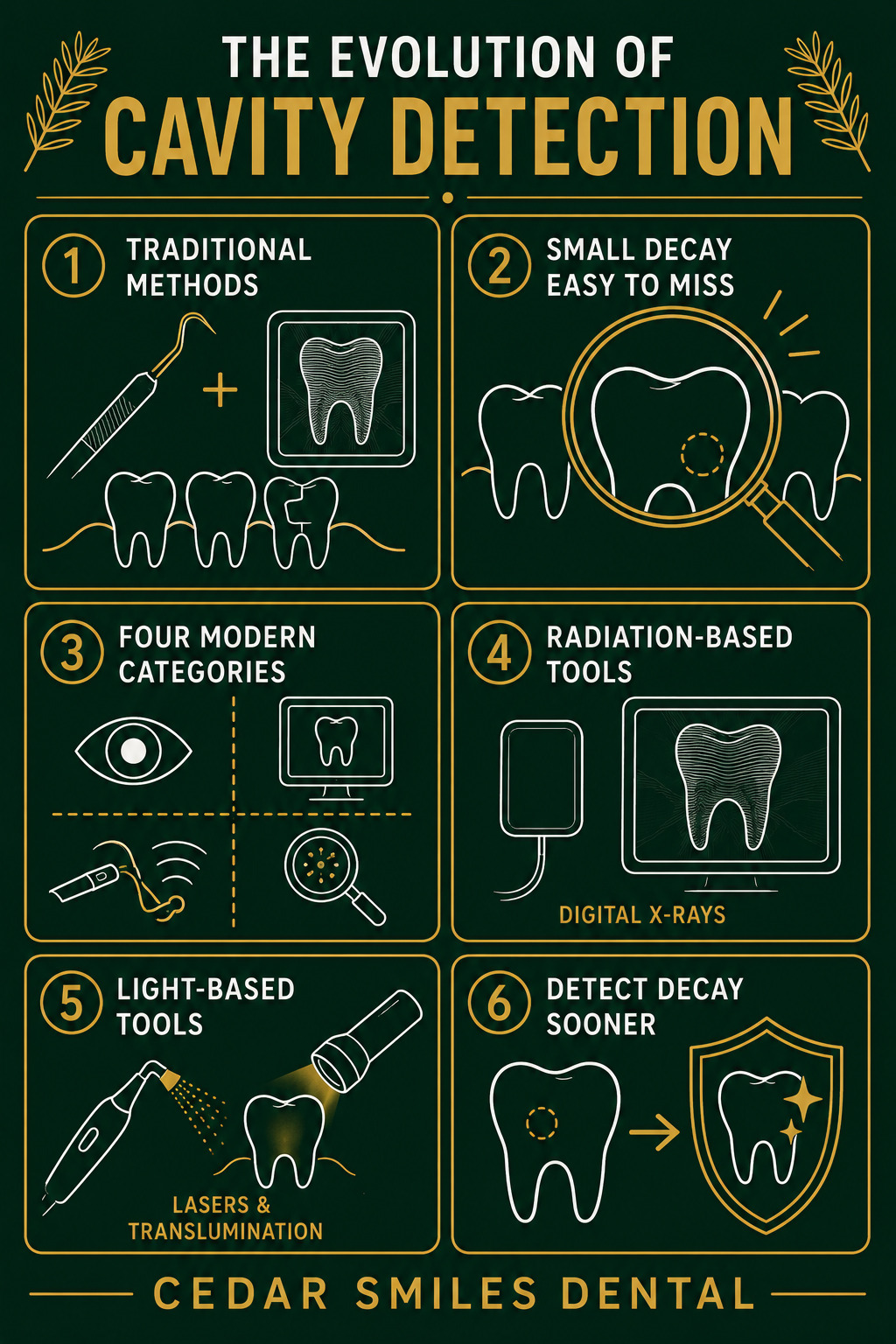
Traditional cavity detection meant probing tooth surfaces with a sharp explorer and reading black-and-white X-rays. Both methods still play a role, but each has real limits. Small cavities between teeth, early enamel damage, and decay hiding beneath old restorations could all go undetected until they grew large enough to cause symptoms..
Digital X-Rays: A Clearer Starting Point
Digital X-rays remain the foundation of cavity detection and represent a meaningful step forward over traditional film. Images appear in seconds, may be enlarged, and expose you to far less radiation than older methods.
Still, even digital X-rays have a known limitation when it comes to early decay. Research has shown significant variability in their sensitivity, particularly in detecting cavities between teeth at their earliest stages. This is precisely why thorough dental exams and cleanings pair digital X-rays with additional tools rather than relying on them alone.
Intraoral Cameras: Bringing You Into the Conversation
Intraoral cameras do more than help dentists see. They allow you to see too. These small wand cameras capture high-resolution images of the entire mouth, including hard-to-reach areas in the back. In an American Dental Association new-dentist feature, practicing dentists described intraoral cameras as a useful patient education tool, valuable not just for diagnosing but for helping patients visualize what the dentist is describing in high definition. One dentist noted that when patients actually see caries, stains, or plaque up close, they become more engaged with their dental treatment and care.
When you can see what your dentist is describing, the conversation changes. You are no longer taking someone else’s word for a condition you cannot see.
Why Early Detection Changes the Outcome
The case for better detection comes down to preserving tooth structure. The earlier a cavity is identified, the more conservative the treatment may be.
Here is what that progression can look like:
- Enamel-stage cavity: Remineralization or a small filling
- Dentin-stage cavity: A larger filling or crown
- Pulp involvement: Root canal therapy followed by a crown
Every stage beyond the first represents more time in the chair, more tooth structure lost, and more cost.
Catching issues early also supports better outcomes for related concerns. Undetected decay can contribute to gum disease over time, and routine exams give us a chance to spot both.
What This Means for Your Next Exam in Somerset
A thorough dental exam is more than a quick mirror check. It is a diagnostic process, and the tools used in that process directly affect what gets found and what gets missed.
At Cedar Smiles Dental, Dr. Wong built this Somerset practice around genuine, attentive care. We are a private practice, not a corporate office, which means your exam reflects your individual needs rather than a schedule. If you are ready to establish care with a dentist who takes the time to get it right, contact us to schedule your visit.